 |
Talking About MarketingThe only thing worse than being talked about, is not being talked about... Author: Auscast Network
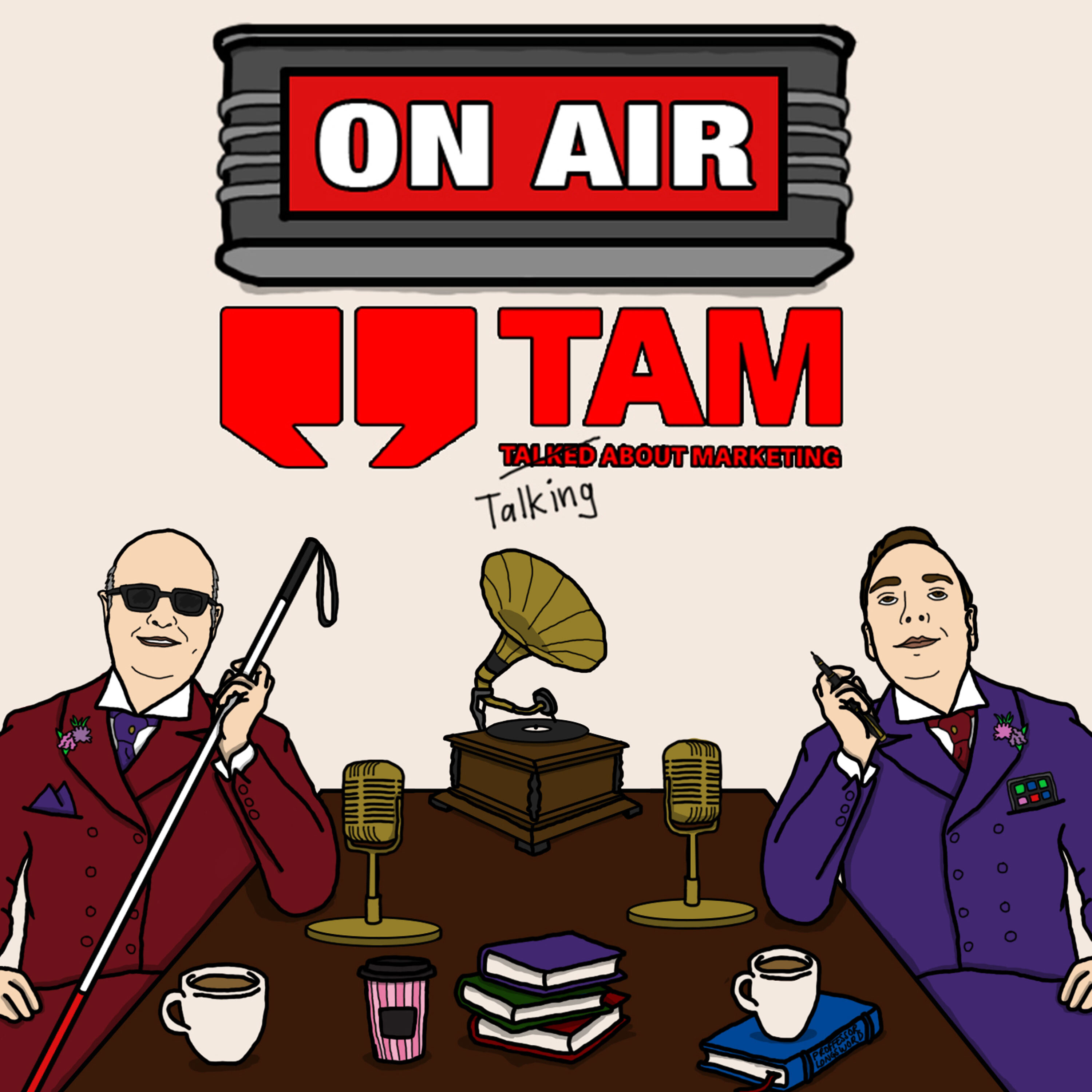
Talking About Marketing is a podcast for you to help you thrive in your role as a business owner and/or leader. It's produced by the Talked About Marketing team of Steve Davis and David Olney, with artwork by Casey Cumming. Each marketing podcast episode tips its hat to Philip Kotler's famous "4 Ps of Marketing" (Product, Price, Place, Promotion), by honouring our own 4 Ps of Podcasting; Person, Principles, Problems, and Perspicacity. Person. The aim of life is self-development. To realise one's nature perfectly-that is what each of us is here for. - Oscar Wilde Principles. You can never be overdressed or overeducated. - Oscar Wilde Problems. I asked the question for the best reason possible, for the only reason, indeed, that excuses anyone for asking any question - simple curiosity. - Oscar Wilde Perspicacity. The one duty we owe to history is to rewrite it. - Oscar Wilde Apart from our love of words, we really love helping people, so we hope this podcast will become a trusted companion for you on your journey in business. We welcome your comments and feedback via podcast@talkedaboutmarketing.com Language: en-us Genres: Business, Education, Marketing Contact email: Get it Feed URL: Get it iTunes ID: Get it Trailer: |
Listen Now...
The Duty Of Australians In Business
Episode 4
Monday, 13 April, 2026
In this episode, Steve Davis and David Olney take Lawson’s poem The Duty of Australians seriously, not as nostalgia, but as a working framework for building businesses that last. Alongside that, they wrestle with a 1985 book that predicted social media addiction decades before the first smartphone, examine a CEO’s cringe-worthy burger video, and flag a quiet data-harvesting threat hiding in the app store. Get ready to take notes. Talking About Marketing podcast episode notes with timecodes 02:45 Person This segment focusses on you, the person, because we believe business is personal.What Henry Lawson Knew About Culture Duty arrives early. South Australia’s premier quoted Henry Lawson’s poem The Duty of Australians on election night. The verse urges Australians to welcome newcomers, find them people who speak their language, and make space for them to become part of what’s being built. Steve and David found it worth unpacking for anyone running a business. The core insight is this: you cannot assimilate until you have language. Steve knows this firsthand, having lived in Hungary in the early 1990s where finding other English speakers was the bridge that eventually allowed him to become part of Hungarian society. The same principle applies inside your business. David makes the connection plain. Inclusive workplaces are not a nice-to-have. They are the fastest path to higher productivity, better behaviour in front of customers, and stronger resilience in hard times. And the place to start is not with customers — it is with the people you hire. If your staff look miserable while you waffle niceness at customers, every customer notices. The harder truth is this: we now have smartphones, social media, and algorithmic echo chambers that allow people to live in entirely self-constructed worlds. Building genuine connection takes more deliberate effort than it once did. David’s suggestion is to start in the square metre where you are working. Because at work, everyone is already on common ground — shared purpose, shared customers, shared stakes. It turns out the phrase “work-life balance” may have the right word first. 13:45 Principles This segment focusses principles you can apply in your business today.Amusing Ourselves to Death Neil Postman saw it coming. His 1985 book Amusing Ourselves to Death argued that the real dystopian threat was never George Orwell’s vision of forced oppression — it was Aldous Huxley’s vision of a population that would willingly surrender its attention and agency in exchange for endless entertainment. Postman was writing about television. He did not live to see social media. He did not need to. Steve and David note that a US jury recently found Google and Meta liable in a landmark social media addiction case, with a 20-year-old woman’s claim that these platforms were deliberately designed to be addictive. A Meta representative reportedly suggested that 16 hours of daily Instagram use might be “problematic” but not quite addiction. Draw your own conclusions. What does this mean for your business? David frames it directly: why did you start your business? It was almost certainly not to amuse people to death. You probably wanted to solve a real problem, deliver a genuinely uplifting experience, or connect customers to something that felt like knowledge or beauty or meaning — not just distraction. The tools of social media are unavoidable. You need to be present where your customers are. But Postman’s real counsel, as Steve reads it, is awareness. When you understand the limits of these platforms — that they are shallow by design — you stop expecting depth from them and start using them intentionally. Content that informs, entertains purposefully, or genuinely helps someone is doing something the platform itself was not built to do. That is worth doing. 25:00 Problems This segment answers questions we've received from clients or listeners.Stranger Danger for Apps Not all AI is equal. A Mashable article flagged ten apps among the worst offenders for leaking personal data. Most of them sound uncannily like the legitimate tools many of us already use — names like “Chat and Ask AI” and “Chatbot AI” that sit in app stores, free of charge, right alongside the paid versions of trusted products. These apps harvest chat history, search behaviour, and personal disclosures — the kinds of conversations people have about medical conditions, financial concerns, or relationship difficulties. That information trains the app and, depending on the terms of service, can be sold. David’s advice is straightforward: read the terms of service. And Steve adds a practical upgrade to that — if you are not going to read a long and confusing document yourself, copy and paste it into a trusted AI tool like Gemini and ask it to assess what you are signing up for. Using technology to scrutinise technology is a reasonable form of self-defence. The short version: stick to known quantities and apply the same scepticism you would in any other unfamiliar situation. 29:45 Perspicacity This segment is designed to sharpen our thinking by reflecting on a case study from the past.The McDonald’s CEO and the Big Arch Authenticity still needs to be engaging. The McDonald’s CEO posted a video of himself tasting the new Big Arch burger. It did not land well — not because of the burger, but because of how he spoke about it. He referred to it as “product.” He mentioned it had already been tested in Portugal, Germany, and Canada, which the audience heard as “we tested it on people with lower standards.” His camera presence was flat and his enthusiasm unconvincing. Steve and David are clear that this is not an argument against authenticity. It is an argument for recognising that authenticity still needs a yard rule held against it. Will this convey genuine enthusiasm? Does it have something useful or interesting to offer the viewer? If not, it probably should not be published — regardless of how real it feels. By contrast, the television advertisement for the same Big Arch burger fared considerably better. It focused not on ingredients but on the simple promise of a large, filling meal when you are genuinely hungry. There was honesty in that simplicity. Steve and David gave it a mark above midpoint — modest praise, but meaningfully better than the CEO’s effort. The takeaway is not that you need a production crew. It is that publishing something unpolished does not automatically make it trustworthy. Authenticity and purposefulness are not opposites. They need each other.See omnystudio.com/listener for privacy information.