 |
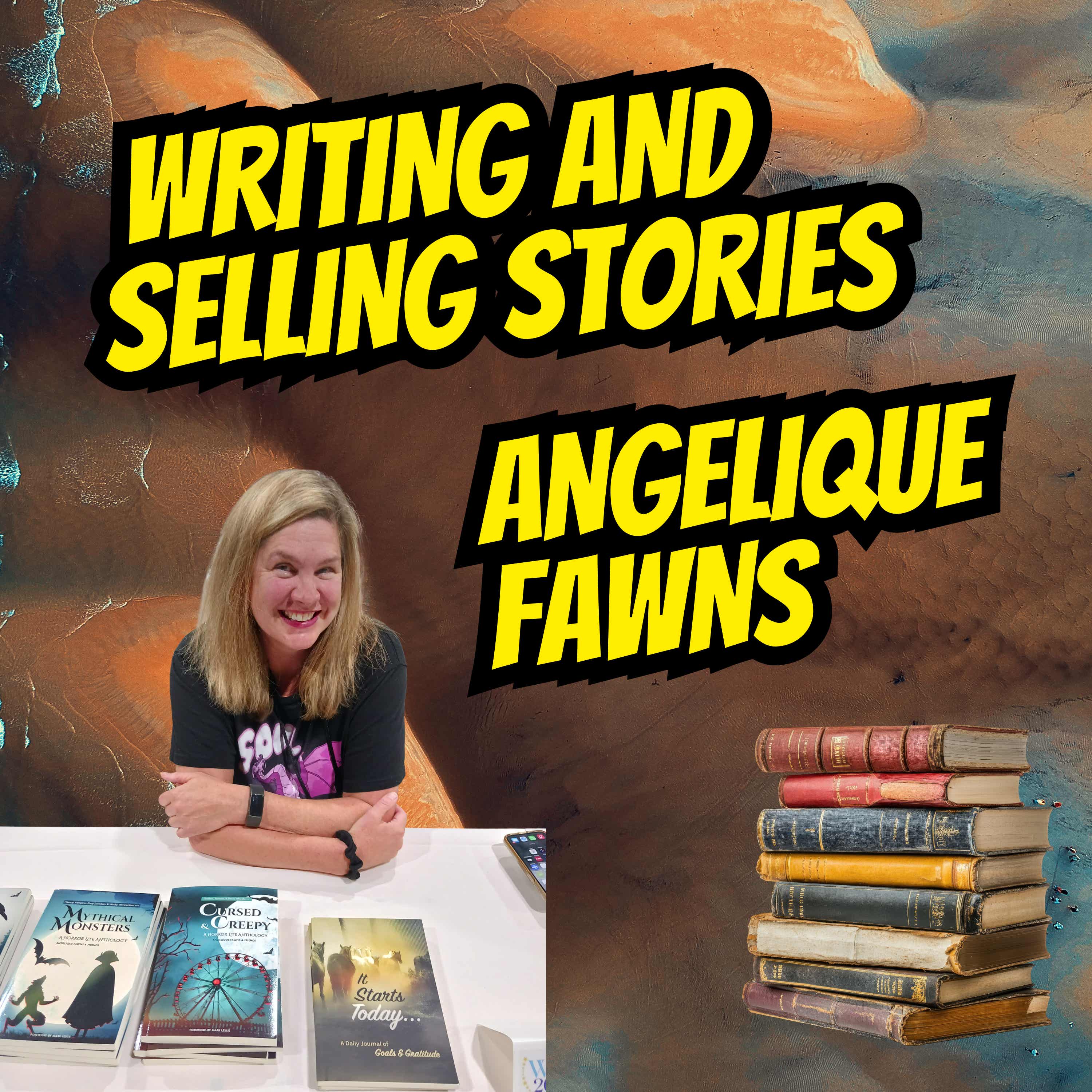
Writing and Selling Stories with Angelique FawnsAngelique Fawns is an author and journalist. Writes thrillers, space-opera, cowboy adventure romance, and HORROR. Famous for her PAYING NO-FEE open submission short story call list. Author: Angelique Fawns
Season 2 of "Read Me A Nightmare" shifts its focus to conversations with writers, editors, and creators working in and around dark fiction about craft, career, and the realities of making stories in the world.Visit www.fawns.ca to learn more. Please --if you enjoy the episode, leave a review! angeliquemfawns.substack.com Language: en Contact email: Get it Feed URL: Get it iTunes ID: Get it |
Listen Now...
Fat Vampire & The Artisan Author with Johnny B. Truant
Sunday, 20 September, 2026
The video of our chat is HERE.What’s my number one goal? To sell IP to film and television.You know who’s done it?Johnny B. Truant Imagine my delight when I was contacted by my favorite horror writer in Canada, Mark Leslie Lefebvre and asked if I was interested in interviewing Johnny B. Truant about his upcoming Kickstarter.Ummm.HELL YES.Ps. Here is his Kickstarter if you want the fanciest edition of Fat Vampire (on it’s thirteenth birthday) EVER. https://www.kickstarter.com/projects/johnnybtruant/fat-vampire-10th-anniversary-special-edition-2-volume-setHere is his bio in his own voice:I’m the author of Fat Vampire (which became SyFy’s Reginald the Vampire), plus 100+ books across most genres. My books are layered, intelligent, and often funny. I love what I do, never cut corners, and would rather earn 10 true fans than sell 10,000 copies.AF: Let’s talk about Fat Vampire. You’ve had the book adapted into the TV series Reginald the Vampire. How did that actually happen?J.B.T: People say, “How do you make that happen?” I say:“I didn’t make that happen. I did nothing to make that happen.”The book existed in the world, and a producer who worked for the BBC, of all places, was getting on a plane and needed something to read. He found it on Apple Books.Then he told two of his friends, Jeremiah Chechik and Harley Peyton, “Hey, I think this is up your alley.” And then they read it and contacted me, and then they made the TV show.(Authorial note: I didn’t know those two guys, so… here you go: Jeremiah S. Chechik is a Canadian film and television director and photographer. His feature work includes National Lampoon's Christmas Vacation, Benny & Joon, Diabolique and The Avengers. Harley Peyton is an American screenwriter and television producer.[1] He worked in both capacities on Twin Peaks and was nominated for the 1990 Primetime Emmy Award for Outstanding Writing in a Drama Series for his work on the series' third episode.)But that circumstance could never have been engineered. Even if I had pitched Harley and Jeremiah—which I didn’t—they had to be between shows, not working on something right now, actively looking. There’s just—everything ends up being luck at some point.But you can’t get lucky unless you have something to spawn that luck. Like having books in the world.AF: Did Reginald the Vampire translate into a big increase in your book sales?J.B.T: No. I would say that it’s good as cred. I got a good payday for the show and I got to go and be on it and everything.But has it made a huge difference in book sales? Not directly. It gives me a reference. It gives me social proof to be able to say that it’s a TV show, and that sort of thing is useful.It’s become kind of a keystone thing in that people do know it. It’s not like there was a big bump when it showed up. But maybe if the show had been bigger, then it would have been.AF: What was your experience like working with the production?J.B.T: The production was very gracious with me, and it’s no surprise. It’s Canadian production. Like, you’re just nicer up there.(Authorial note: Thank you! Sorry, I think we are very nice.)I was told that from end to end, the whole production was kind of a unicorn in that everybody was kind of nice. There wasn’t that kind of cutthroat culture that you hear about sometimes.AF: You were also quite involved in the TV show, weren’t you?J.B.T: I don’t think my experience was typical. I got to sit in the writers’ room a couple of times. I don’t think most authors get to do that, but I wasn’t precious.They’d ask about things, and I basically said, “I don’t care what you do. It’s your IP now.”It’s collaborative. It’s a different medium. It’s budget constrained.There were a bunch of decisions that they made because they had to make them because of budget. And I don’t have to worry about budget when I’m writing.I wish that more writers would understand that TV or movies and their books are a fundamentally different thing.AF: What changed?J.B.T: My Fat Vampire novels are third-person limited. So if Reginald, the main character, isn’t there and doesn’t hear it and see it, then you don’t know it.That doesn’t really work on TV.So they had to create all these other characters and all these POVs, and they needed to be able to shift from an A story to a B story. And that’s not the way books are written.You can’t adapt them one-to-one. Just because the audiovisual version is not the same as the book does not mean that it is screwed up inherently.They used the same premise to create something that worked for that medium.AF: You were part of a companion podcast for the TV show, weren’t you?https://johnnybtruant.substack.com/podcastJ.B.T: Yeah. When I pitched this originally, it was maybe a month, maybe even less, before the first season of the TV show came out.I said, “I can do a companion podcast.”And so if it’s coming out every week and you can release a companion podcast to go with it and then put a trailer at the beginning or the end—“Watch the companion podcast. Listen to the companion podcast”—then that’s a great promotional vehicle.I was sending them articles about how companion podcasts are the thing and how they really help.AF: So what happened?J.B.T: The whole process took so incredibly long that I had gone to visit the set for season two before I even was able to line up interviews for season one.So season two hadn’t aired, but I was like, “Okay, it’s okay, you guys. We’ll just drop all the season ones.”They’ll be kind of weirdly homeless. Nobody’s going to know what to do with them. But then we can do it right for season two.Of course, the show got canceled.So I didn’t continue with season two.I ended up with eight of ten episodes fully produced, fully ready to go. And then I was like, “Well, what am I supposed to do with these?”So that’s what I’m doing now: putting them out.The podcast is called Reginald the Vampire After Sunrise, because it’s like after dark, but they’re vampires, so it’s after sunrise.It’s on all the podcast places.It’s fun to go back and listen to my interviews with the cast and the producers and discuss the episodes, but also discuss what it was like to portray these characters and vampire lore and how it differs in different situations and stuff.It was cool. And I’m kind of sad that they went unlistened to for so long.AF: And now you’re bringing Fat Vampire back in a completely different form—a special 13th-anniversary edition. Why this particular project?J.B.T: For Fat Vampire, it’s 13 years old now, and that’s a witchy number, 13.It’s the 13th anniversary.I want to do a special edition of a book that already exists, that people already know about, which is a different animal than I’ve done before.I can’t just have it as a by-the-way. It needs to be like the main entrée. It needs to be the thing. I’ll offer audiobooks and ebooks and all that. They’ll be there for people who’ve never heard of the book.But the core audience that I’m trying to serve are the people who already know about it and like it and want this big tome.AF: And this is where Kickstarter comes in?J.B.T: It’s a huge gut check because I can’t do print-on-demand. I’m doing an overseas print run.This campaign has to bring in like, what, eight, nine, $10,000 before I can even do it.And in the past, that hasn’t been a thing. Technically speaking, if I were to set the goal accordingly and somebody bought one book, okay, I can sell that one book. I can do that in a print-on-demand culture.But this is a print run. I have to pull up the big-boy pants.So we’ll see.AF: You’ve done quite a few Kickstarters. What have you learned about them?J.B.T: Maybe not everybody should do Kickstarter.You have to ask: Do you have the right temperament? Do you have the right catalog? Are your books kind of optimized from a conversion and cover perspective? Are you good at talking to people? Do you have pitches?So in no way am I saying that Kickstarter is, quote, a good idea, full stop. But for me, it is.AF: You’ve said something similar about all the current “must-do” strategies in publishing—rapid release, Kindle Unlimited, live selling, social media. You seem pretty skeptical of the idea that there’s one formula.Authorial note: Johnny B. Truant wrote a whole book about finding sanity in the current rapid release, burn out culture in the industry.J.B.T: I refuse to give real definitive answers.There’s no shortcut to learning. The mentality should be making your own path rather than, “I’m going to give you a path.”I can retroactively draw you a map. This is what I did.But unless you start in exactly the same place as I am, a map only works if you start in the exact same place, facing the same direction, and have the same supplies and the same everything.That’s why I don’t give you the answers. Because it’s crap to do so.It really annoys me to death when you see people who are like, “This is the answer.”I’m not a fan of rapid release at all, but it works for some people. I’m also not a fan of Kindle Unlimited. But again, that’s for me.Then I see somebody like Matt Dinniman, where KU is a huge part of his success. He really praises KU.So that’s his genre. That’s him. And he’s a smart guy.It really just depends.AF: So what do you think is actually underneath all of this? What remains true regardless of the latest publishing trend?J.B.T: Finding a reader who likes your work is really all it’s about.It’s about finding the right reader in the right place at the right time.And that’s really all there is to it.AF: And that brings us back to luck, doesn’t it?J.B.T: Absolutely.The Reginald the Vampire thing didn’t make my books blow up, but it could have.It certainly was a payday, and it led to connections and it led to social proof.So that’s my piece of good fortune.But you can’t plan on that.You can’t engineer the guy getting on the plane, needing something to read, finding your book on Apple Books, telling the right people about it, and having those people be available and interested.Everything is luck at some point.Well… that was a thoroughly enjoyable conversation!One last time, here are his links.For the Artisan Author: https://buy.bookfunnel.com/ux3l6solvhFor the Fat Vampire special edition: https://www.kickstarter.com/projects/johnnybtruant/fat-vampire-10th-anniversary-special-edition-2-volume-setFor all other things Johnny: https://johnnybtruantbooks.com/And if you are in to Kickstarters? I’m running one myself!https://www.kickstarter.com/projects/angeliquefawns/the-roxie-vega-chronicles-a-space-opera-adventure-romance This is a public episode. If you'd like to discuss this with other subscribers or get access to bonus episodes, visit angeliquemfawns.substack.com/subscribe